29 January 2014

The Tween Roller Coaster

Over the weekend, the girl asked me to take her to the Metropolitan Museum of Art so she could sketch in the Greek/Roman sculpture galleries. Yes, where all of the people are naked and most of the men have had their penises lopped off. She’s 10. Oy.

But I'm a good mother and I like to encourage trips to museums.


We wandered through other bits of the museum too. There was a cool exhibit of mid-century Venetian glass, where we both took a lot of close-up phone photos until a guard chastised us. And we were both decidedly unimpressed with the jewelry show. Would you wear that? No, would you? And somehow, we ended up in a gallery with a fistful of Georgia O'Keefe paintings. Being the subversive mom, I decided I had to mention that many people think many of O'Keefe's paintings look like...yeah. Her response? I know.

It's a funny age. On the one hand: I WANT TO GROW UP. On the other hand: I'm still a little girl. We wobble-wobble between the two.

Last week we had the small drama of:

My armpits smell
Hmm, yes they do. We'll have to go get you some deodorant.


She's now applying antiperspirant three times a day, even though I keep telling her once a day is more than sufficient.

[We did have a nice dinner conversation about the word "lapse" and the concepts of pre- and post-lapsarian.]

Tonight I navigated her through the minefield that is texting, this time a group text that got completely out of hand. Delete me. I HATE YOU. Part of the problem is that the children, for they are still children, haven't any idea how to deal with a group text. No one wanted it to continue, but they all kept saying "delete me", "I deleted this message", "stop texting me" - which meant that it kept going and going and going. And then, there were hurt feelings, not unwarranted, but oh the drama.


I am glad, though, that she texted me (and only me) and told me it makes me feel really bad / I don't like that feeling and wanted to know when I'd be home. We had a good heart to heart about kids and relationships and what other people might be feeling and why group texts and reply-all are often misused.

And then, later in the evening, as she was tidying up before bed, she piped up with I think me and (BFF) are the only girls in fifth grade who like dolls. The other girls, they're trying to grow up too fast.

It's a goddamned roller coaster is what it is.

28 January 2014

Oh, Pete

Last spring, I found out that Pete Seeger was playing a benefit concert at a Unitarian Church not too far away from where we live. Pete! In spitting distance! So we went, and took the girl, because we thought it was important for her to grow up knowing she'd been in the same room with him, and we swooned a little when he ambled onto that stage, banjo slung upside down on his back.

We sing "his" songs all the time. Loudly, in the car, Here's To Cheshire, Here's To Cheese. Quietly, at bedtime. Raucously, reverently. And even when it's not Pete singing, it's people informed by him - Arlo Guthrie, Bruce Springsteen, Sweet Honey in the Rock.

Pete was a part of my childhood. There was a concert series every summer in the town next to ours, and there were always good people playing: Oscar Brand, Odetta, Pete Seeger, Arlo Guthrie. Pete's environmentalism, his anti-war activism, his general lefty-commie-pinko sentiments course through my veins. Somewhere in a drawer, I've got a button, "Clean Up Big Muddy", a souvenir call-to-arms from the early days of Pete's campaign to clean up the Hudson River.

Arlo Guthrie does a side-splitting version of The Garden Song, Inch by inch, row by row // Gonna make this garden grow, in which he talks about how Pete sings "in front of the song", giving you the line just before you need it, teaching people to sing. Pete does just that, here in We Shall Overcome.


Because I am an optimist, I do believe that one day, we shall overcome, and that this machine will surround hate and force it to surrender. Rest in peace, Pete. And thank you.

27 January 2014

Garbage Pail Gratin

My mother lived alone for many years, and as a result, had a rather zen thing about eating. In the summer, dinner was a salad. Greens, crunchy bits, chick peas, maybe some feta. In the winter, it was garbage pail soup. She'd make a big vat of vegetable soup, starting with chicken stock and adding whatever was lingering in the freezer, a handful of lentils or maybe some beans, a parmesan rind if one was at hand, and a spoonful of pesto at the table. No recipe, just instinct. Mind you, I'm not going to say that it was great soup, but it was warm and cheap and healthy.

I kind of love Martha Rose Shulman. She does these columns on the New York Times website, where she'll dive into something and give you four or five semi-variants. Recently, she did gratins, Not Your Grandmother’s Gratin:

Potato and Sorrel Gratin
Roasted Squash and Red Onion Gratin
Fennel, Kale and Rice Gratin
Roasted Cauliflower Gratin With Tomatoes and Goat Cheese
Roasted Eggplant and Red Pepper Gratin

After skimming through all of those recipes, it occurred to me that they were all, at core, the same: vegetables and a grain/starch plus eggs, milk, cheese.

So I sautéed an onion, boiled and sliced a few tired potatoes, added a bag of frozen Swiss chard/beet greens (from last summer's CSA), added a cup of cooked wild rice, mixed it all together and dumped it in an oiled baking dish. I then added 3 eggs beaten up with 1/2 cup milk and some salt and pepper, sprinkled some grated cheddar on top and threw it in the oven. And it was good.

In other words, don't be afraid to invent.

17 January 2014

How To Have A Party

The very back of my mother's black book has a section on entertaining - a diary, if you will, recording dates and guests and menus for parties. And when I look at the page of her notes on the Christmas Eve party, it's like a road-map. This is what you serve for an open house. This is how you do it.


You have cookies, fruitcake (my grandfather sent us one every year), pretzels, crackers & melba toast (which you make out of party rye). You have hot cookies (spicy cheesy sesame shortbread "pennies") and "Boursin spread" and chicken livers. Later, sometime after 1978, we'd add cheese and pickles and olives and nuts to the menu, and eventually the fruitcake stopped coming.

Oddly enough, the recipe for the chicken livers wasn't in the black book - it was in the file box. But I'd once copied it into my own recipe book, and, because I'm a good sharer, here it is, down at the bottom of the page. Make it for your next open house. People will love it.

Parties always want crunchy cheesy things. For the open house we had before Christmas, I included John Wm. Macy's crunchy cheese sticks, which are the kind of thing you find at fancy parties and can't stop eating. Truth be told, I had them in the house because a publicist sent me some, but truth be told? They're really good and I'd buy them again in a minute.

The other crunchy cheesy thing I served was a sort of apple/onion/blue cheese pizza, from a New York Times recipe. It was easy to make, and cut into 2" squares, it got scarfed down by the wine drinkers who never left the kitchen. What is it with the kitchen? Always have some food in the kitchen at your open house, because some people never leave there.


Chicken Liver Pate

1 pound chicken livers
2 sticks of butter (at room temperature)
1/4 of an onion
1/8 t. dried basil
1/4 t. anchovy paste
2 T. cognac
salt
pepper

Melt one stick of butter. Sauté the livers in the butter until brown outside but still pink inside, about 5 minutes. Set aside to cool, in the skillet, until the butter firms up. Transfer to a food processor. Add the second stick of butter and mash to a nice paste. Add other ingredients. Transfer to a serving dish - I like to pack it in a crock or something where you can smooth over the top. Serve it with melba toast, the kind you make yourself out of a loaf of party rye, stuck in a low oven for a while.

Note: I always add the dried basil, though I don't know why. And I never add the anchovy, though maybe one day I'll be brave and try it.


Disclosure: I didn't buy the Macy's Cheese Sticks; the publicist sent them to me. No one paid me to write about them, and my opinions are my own.

16 January 2014

Moky's Black Book

One of the things I did for Christmas was make scanned-printed-bound copies of my mother's cookbook, her well-loved, oft-repaired black book, as gifts for my brother and sister. It was her repository of recipes, tried and true, and perhaps never tried at all. Some are edited, or annotated: “good w/ peas instead of carrots”. Some were cut out of magazines or newspapers, glued into the black book, tried, and ripped off the very page - no good, bland, awful, never make this again! And some are part of the family history - Butterflied Leg of Lamb followed by Fruit Ice Cream? Yup, that sounds like dinner.

For me, reading it is a huge nostalgia trip. The Seven Layer Dinner is, I think, the meal that got served to Aunt Gertrude once - it didn’t cook long enough and the potatoes were raw. Then again, maybe it was the Lamb-Potato Casserole - that too has raw potato layered with the meat. That lamb-potato casserole also has the note “add 1 c. garlic”. I have to think that’s one clove, not one cup. The Duck with Lentils has this uncharacteristic note from the woman who didn’t generally cotton to fruit or other sweet notes in savory dishes: “more apple would be good”.

Lots of friends and relatives supplied recipes which made it into the book. There's a hand-written recipe for Shish Kebabs in my grandmother's hand, which Moky edited to “omit” the ground chili. Gigi - my grandmother - also appears with a recipe for Brownie's written out my handwriting, complete with that errant apostrophe.

Possibly the simplest recipe is Elizabeth’s Pork Chops:

Close together in
pan - cover
w/ milk
350 °F for an
hour or more

A couple of the printed recipes include pricing - a nod to the economizing housewife. The punch recipes are said to cost $15-$25 for fifty servings. And Lydie Marshall’s Poulet a la Grecque says that a 2 1/2 pound chicken will cost $1.42. Um, right. But the recipe sounds tasty - chicken and onions and tomato sauce and feta, baked and served on orzo.

Making the book was a labor of love - I scanned about 150 pages, made a half-assed (idiosyncratic and incomplete) index, wrote an essay of sorts, and uploaded the whole shebang to Blurb. But it was about my favorite gift that I gave anyone this year, and I had a third copy printed just for me - and for my daughter, one day.

13 January 2014

Homographs

Someone I know is a great player with words - he can find palindromes at the drop of a hat, DENIERS REINED being a recent great example.

But every time I see the word DENIER, I mispronounce it in my head and confuse myself - because

DENIER = one who denies = De Nye Er

but also

DENIER = a unit of measure for how sheer your stockings are = De Near

Homographs are just another delightful confusion wrought by our English language.

10 January 2014

All Manner Of Games

A couple of years ago, I read a book by Jane McGonigal called "Reality Is Broken: Why Games Make Us Better and How They Can Change the World". It was oddly fascinating book, a taxonomy of games, mostly online games, but not all, with a methodical explanation of how games make us smarter and happier, and how we can collaborate - game-ways - to make the world better. At the time, I thought it was hugely ambitious, largely successful, and fairly irrelevant to my life.

Curiously, though, it's a book I think of often. I think about it when I check in someplace on Foursquare, especially places like the local farmer's market, where I move in and out of the mayorship on a regular basis. Foursquare is essentially a game - checking in gets you points, points get you to the top of the list, WIN! And for the farmer's market, I figure that if I remember to check-in, maybe one of my local friends will see it and head down to visit the market - because the market gets better when more people shop there. So it's multi-purpose, my check-in: help the market, coddle my competitive streak.

We recently invested in a Nest thermostat. The Nest is wifi-enabled, so big brother knows when you've goosed the thermostat. And it sends you monthly reports that cheer you on: you did great, you're in the top 20%, you used more energy but it was really cold out. You can even control it from afar with an iPhone app. I kind of wish I'd remembered to do that last weekend: we'd been away, and left the house at 55°F - if I'd been on the ball, I could have told it when we were on the way home, so the house would have been a little less than frigid. [I saw a guy doing just that on the subway the other day.] Anyway, at core, part of the Nest's appeal is its encouragement of better habits through rewards, i.e. game-like behavior.


The present array of fancy pedometers on the market speaks to the gamification of fitness: share how many steps you took, and compete with your friends on who climbed more stairs. As it happens, I spent four weeks wearing two such devices: a FitBit One and a Wii Fit U Fit Meter. Honestly, I don't walk enough - it's what comes of having a desk job - but I like the idea of trying to best myself, trying to get more stairs in, more steps in.

I had the Wii Fit U Fit Meter because - as you know - I'm a Nintendo brand ambassador. I've had the FitBit for a while. While they both count steps, they differ in interesting ways.

The Fitbit One wirelessly syncs to your computer. You can log on to their website and check your results, and you can set it up so you get weekly status reports. It's also possible to create a community of friends - so you're competing on steps, again with the competition. The FitBit counts steps and floors (flights of stairs), and estimates miles and calories. You can use it as a sleep tracker, too, but I don't. (I'm a good sleeper.) And it'll give you badges for milestones. You walked 15000 steps? Badge for you! Oh, and it has a clock.


The Wii Fit U Fit Meter tracks steps and altitude (in feet), and has a clock. Oddly, it also has a thermometer - all well and good if the thing is sitting on your desk, but if you're wearing it, slipped into a pocket, the thermometer is useless because it's reading neither ambient temperature nor body temperature, but some irrelevant admixture. [I just took it out of my pocket - it's reading 87.6°F - way higher than room temperature, and way lower than body temperature.] The Fit Meter needs to be synced to the Wii U console, a slightly fiddly transaction where the Meter has to be pointed at just the right spot on the console. Once you've done that, though, you can check your progress on your walking tour of Italy:


Or your scaling of the Eiffel Tower:


As I said, I was wearing both the FitBit and the Wii U Fit Meter for a while. Because I am a geek, I noticed that the two devices were giving different readings, different by some percentage points not by just a few steps. If I was wearing them each clipped to a belt loop - i.e. up near my waist - the FitBit recorded more steps (6546 to 6088, or 6126 to 5770). One day, though, I dropped them both in the pocket of my jeans - where they were riding lower on my body. That day, the Wii U read higher, 7452 to 6514. Without getting all scientific about it, I haven't any idea which of the devices is more accurate, but clearly they aren't perfect systems.

Anyway, if you're looking to gamify your fitness, a fancy pedometer is fun. Besides, like The New York Times said, "it’s cheaper than joining a gym". And if you're fascinated by gaming's inroads into everyday life, read McGonigal's book". Reality isn't broken, it's just being codified and tracked and socialized in more and more ways.


Disclosure: I was sent the Wii Fit U Fit Meter by Nintendo, but without any expectation of a review, and with no compensation. My opinions are my own.

07 January 2014

Creative Chaos of the Fictional Variety

Interestingly enough, while I was reading Seven Life Lessons of Chaos, I was simultaneously reading Nick Harkaway's Angelmaker. It's a book that I probably wouldn't have stumbled upon, but for an imaginary friend whose review so intrigued me that I put it on my list. And, probably because I was primed for chaos and fractals, I found myself sticking yet more post-its in a library book, harnessing the synchronicity:

I had not considered the idea; rather than seeking to rule out variations in quality, accept and adopt the reality of imperfection. A very powerful model indeed.

The book is throughly enjoyable - a war story, a spy story, a clockmaker and gangster and dictator story, complete with two time periods and mechanical bees.

The saddle of the bee comes away, wings and all, revealing an inner cavity. Even through the loupe, he can barely make out the parts. Cogs, yes. Springs. Everything spiraling downward, inward, smaller and smaller and smaller, each layer geared to take instruction from the one below in a repeating pattern. Cellular clockwork. Fractal clockwork?

The main character is a Spork, another character has a collection of false teeth.

"I've brought my most alarming teeth!"

And indeed, she has, a steel set made in 1919 for an American prospector who like to chew rocks and taste the precious ores.

It's a delicious fantastical yarn. Great exotic characters, a steampunk bent, and a more or less incomprehensible 'machine' at the core. Suspenseful, bizarre, funny, and totally enjoyable. It's not what I usually read, but I loved it.

06 January 2014

Be willing!

My daughter is in the fifth grade, and tacked up on the wall in her classroom is a quote:

The mark of a creative person is a willingness to accept 
ambivalence - the liminal stage between problem 
and solution as a place of both discomfort and possibility.

The quote intrigued me, partly because it evidences a degree of ambition on the part of the English teacher, but also just because. So, I tried to track it down, and located it in an article on Whole Living.

"The mark of a creative person, according to Briggs, is a willingness to accept ambivalence -- that liminal stage between problem and solution -- as a place of both discomfort and possibility."

And so, one thing led to another, and I've just finished reading a book by John Briggs and F. David Peat called Seven Life Lessons of Chaos - which I quite liked, so much so that I filled up the library copy with post-its, and may need to get my own copy.

Chaos is everywhere. Order tends towards it, entropy. And yet, "thousands of tiny interconnections hold the system in place". I behave one way, it affects you. And vice versa. And when we all keep to the right on the subway staircases, we all get where we're going faster. Beauty is often alive with chaos: "Like healthy heartbeats, the rhythmic intervals in such music are always slightly irregular...fractal fluctuation within regularity...brings the music alive." Rivers and coastlines evidence organized chaos, where "apparent disorder masks an underlying pattern."

I found myself thinking a lot about the PTA. The PTA in my town is a bunch of petty bureaucrats, who make everything overly complicated and who tend to do things the way they've always been done because that's the way they do things. But! Now I understand them better - they are a collection of negative feedback loops, obsessive and repetitive:

"Limit-cycle systems are those that cut themselves off from the flux of the external world because a great part of their internal energy is devoted to resisting change and perpetuating relatively mechanical patterns of behavior. To survive in such rigid and comparatively closed systems, everyone must resign a little--or often a great deal--of their individuality by blending into the automatism.  Those who rise "to the top" in such systems are generally the ones who use empty phrases, those mindless formulas that keep the mechanism of collusion together. Limit cycles are the systems that make us feel powerless. They are the ones we want to change but can't because they appear to resist all our efforts. These systems are everywhere in society." (p. 40)

I found myself thinking about my town too, a town that is consumed with agita over two significant potential projects, with angry people on all sides of the arguments. What it needs is a way to "suspend their polarities and non-negotiable convictions long enough for something new to emerge".

Really, it's one of those books that really gets you thinking. My post-its are scribbled with words and fragments:

  • synchronicity
  • o we like sheep
  • ontogeny recapitulates phylogeny
  • the highway system as a distributed airport of take-off and landing strips
  • creativity not competition
  • how to "dialogue" to a new paradigm, not a compromise
  • irrational numbers

The end is apropos:

Rather than ending this book with a summing up, some definitive statement about life and chaos theory, perhaps we should be simply asking a question.

What question shall we ask?

03 January 2014

NO GIFT FOR YOU

Here's what I think. If you go the the emergency room, the hospital should not be allowed to - three months later - send you fundraising appeals that start out:

Going to the hospital is never fun.

But we hope that when you came to [redacted] Hospital, you received top-notch care close to home and you found the Hospital to be a warm, caring place where you were treated with respect.

Because that right there? That solicitation violates the tenets of separation of church and state, and the bright line between advertising and editorial. It's an invasion of my privacy. It's completely improper and wrong. The fundraisers should not know who the patients are. It's like ambulance chasing.

Besides, I'm broke, because that little trip to the emergency room cost me something in excess of $5,000, thank you very much.


Update: Apparently this is legal under HIPAA. But that doesn't make it right.

28 December 2013

The Gingerbread House, part 2

Okay! You've got a big bowl of chilled dough, templates, parchment, a Silpat, cookie sheets, an icing syringe, the ingredients for the glue, a mess of candy, and the patience of a saint? Good. If not, re-read the previous post. I'll be here when you're ready.

Preheat the oven to 375°F.

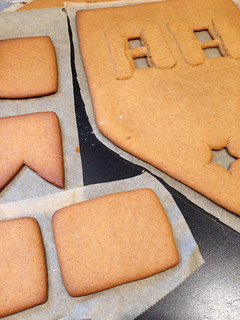
Lay out your Silpat, and lay a sheet of parchment on top. Using a rolling pin with a nicely floured sleeve, roll out a blob of dough on the parchment until it's big enough for your first house piece and about 3/16" thick. Using a pizza wheel, or a gently wielded table knife, cut out your piece. With the knife, nudge the scrap dough away from the house piece.
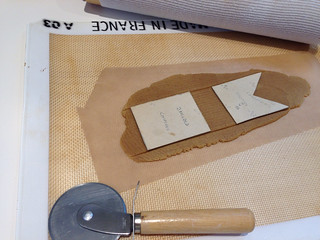
Gingerbread house in the works


Trim the parchment if you'd like, and transfer the dough - ON THE PARCHMENT - to your cookie sheet. Repeat until you have all of the pieces made - and don't forget to make two roof panels, two pieces for the front/back, and two gable end pieces. [Note - you're actually not using the Silpat for cooking. I find that it has a nice stickiness about it that serves to hold the parchment in place on the counter while I'm rolling out the dough. I used to try to glue the parchment to the counter with dabs of shortening, but the Silpat works much better.] If you don't have enough cookie sheets, colonize all the flat surfaces in your house with dough-covered parchment, until the cookies sheets are free again.

You want doors and windows, right? Before baking, cut out window openings, and a door. You can use some of the scrap to make shutters, you can roll scrap into little balls for decoration, you can gently score the chimney sides to make the dough look like bricks. If you're crazy, you can even make window muntins out of thinly rolled bits of dough. You might want to keep the piece you cut out for the door, so that you can later glue it in place propped open. [I used the wrong sized platform this year, and so there was no room for the door. It got eaten by someone.]
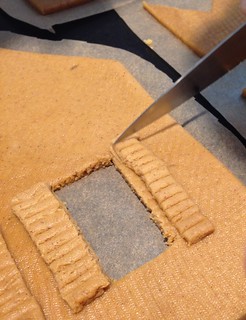
Gingerbread house in the works


Bake the pieces in the 375°F oven for about 10 minutes. You want the pieces to be well-baked, and nicely dry, but not burnt. Cool on the pans. The pieces are big enough that you don't want to risk having them sink - even a little - into the spaces on a baking rack.

Gingerbread house in the works


Stained glass windows are a delightful thing to include in your house, but making them isn't for the faint of heart. I always used to do it by smashing up the sour balls and carefully filling up the window openings BEFORE baking. It was always kind of messy looking though, and when I did it this year, the candy didn't melt properly. So we cut that window out, and hit the google looking for a solution. Ta da! The microwave! Thanks to Heart of Light, we used the microwave to melt the crushed candy in custard cups - which we then spooned into the window openings. Again, stained glass windows are not for sissies - and not for children. Melted sugar is dangerously hot, so be careful.
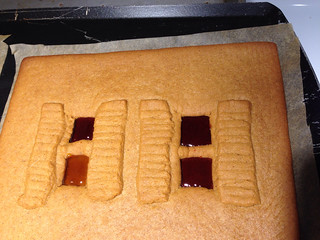
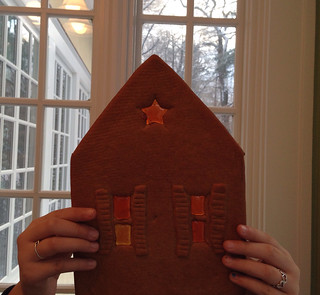
Gingerbread house in the works


Gingerbread house in the works


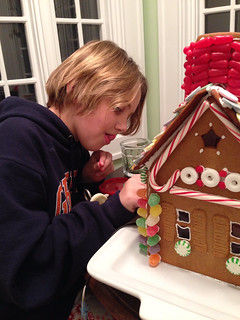
Once all of your baking is done, and your stained glass windows are fabricated, make the royal icing, and find a big board or huge platter to build on. This would be a good time to enlist a helper monkey, like your ten year old.

Also, if you're planning on putting a light inside that requires a cord to exit the house discreetly at the back, you'll want to position the light and make a little cut-out for the cord. This is completely optional, by the way.

Load up your icing syringe and pop on a small plain round tip. [Or use a piping bag or a ziploc - I prefer the syringe.] Peel the parchment off of the back of one of the four sides of the house and run a bead of icing along the bottom. Position it on your board, and get your helper monkey to hold it in place. Find the adjacent piece, run a bead of icing along the bottom and the side that will be adjacent to the first piece. Maneuver it into position, and help your helper monkey hold it in place. Continue around until your four walls are up. If your husband is a wood-working model-builder, he may try and "clamp" the house together with string.
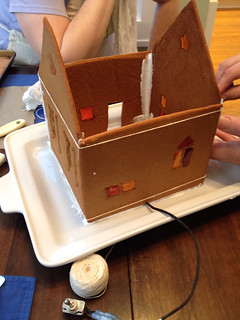
Gingerbread house in the works


Use the icing like caulk and make sure all the gaps between the walls are sealed. Not only does it help with the aesthetics, the icing is structural - it dries like concrete and will help hold your house together.

I cheat at the roof. Using dental floss and a blunt needle, "sew" the roof together with two loops, hinges, if you will. Run a bead of icing along the tops of all of the walls and gently place the roof. Take a deep breath, and pause for a cup of tea. Once the icing is good and dry, add your chimney (if you made one).

Meanwhile, have your helper monkey start unwrapping the candy. I always start with the roof. We used to do it with rows and rows and rows of mini-marshmallows, but Necco wafers are really the best roof tile ever. Work two-handed, and squirt a blob of icing on each wafer as it goes on the roof. Work from the bottom up, just like a real roof.

Once the roof is done, get to work on the rest of the house. I like doing rows of spice drops like quoins, and candy canes can be broken into lintels. I also have OCD control issues, but I did hand the syringe over to the helper monkey. In fact, she did the whole Mike and Ike application for the chimney bricks.
Gingerbread house in the works


You can also tint some of your icing. This is nice if you want to make vines, and morning glories, and Painted Lady Victorian doodads around doors and windows.

Gingerbread house in the works


If you happen to have access to cotton candy of some sort, it makes nice smoke coming out of the chimney. However, it has to be replaced periodically, because it tends to absorb moisture out of the air and collapse into itself.

Gingerbread House


When you're all done, have a party, because you're totally going to want to show off your house. And when the kids go back to school in January, the whole thing is edible, so break it up and pack it off in their lunch boxes.

Enjoy!

The Gingerbread House, part 1

For years, starting when I was about 12, and annually until sometime in my 20s, I made a gingerbread house at Christmas time. It was a major production, and got to be a thing - people expected it, so you did it, so people expected it. I think I've been asked about it every year ever since.

This year, what with the girl having turned 10, I thought it was time to resuscitate the tradition, and so we did. We laid in candy. I located the templates - which had surfaced as we were cleaning out my mother's house. [Have I mentioned that she kept everything? She did.] I made a batch of dough. I dug out the frosting syringe; I got out all the cookie sheets. I convinced my husband to wire an extension switch onto a little battery powered light, and several days later, we were done.

You want to make one too, right?

Here goes. [And if Christmas is twelve days, this post isn't too late!]

Necco WafersYou'll need candy. I'm very particular - no chocolate allowed, fruit flavors only under duress. It's a gingerbread house; the flavors need to be complementary. Or something. So:

CANDY SHOPPING LIST

  • spice drops (spice flavored gum drops)
  • Necco wafers (7-8 rolls - for roof tiles)
  • cinnamon red hots
  • wintergreen Lifesavers (or another solid white flavor)
  • green & white starlights
  • candy canes
  • red Mike and Ikes (chimney bricks)
  • sour balls or five flavor Lifesavers - or other multi-colored hard candy (for the stained glass windows)
  • mini marshmallows


You'll need dough. Make it today, bake it tomorrow.

GINGERBREAD DOUGH (adapted from the New York Times cookbook)
2/3 cup shortening
1/2 cup packed brown sugar
3 T. ground ginger
1 t. cinnamon
1/2 t. ground cloves
1 1/2 t. salt
1 egg
3/4 cup molasses
3 1/4 cups all-purpose flour
1 t. baking soda
1/2 t. baking powder

Cream together the shortening, brown sugar, spices and salt. Add the egg and mix thoroughly. Add the molasses and blend. Stir the baking soda and baking powder into the flour; add flour to wet ingredients and stir well until blended. Chill overnight. [Note: this will make enough for the house - if you want to make gingerbread trees or people or stars, bump it up by 50%, or double the recipe.]


You'll need glue, to glue all of the pieces together and to attach all the candy. Make it last, though, right before you want to assemble the house.

ROYAL ICING (a/k/a glue)
1 1/2 cups powdered sugar
1 egg white
1 t. lemon juice
pinch of salt

Put it all in a standing mixer and beat the hell out of it - it wants to be smooth and white and it will look almost like meringue. Seriously, 5-7 minutes in the standing mixer. Sure, you can do it with a hand mixer, but you'll get bored and tired. Use the stand mixer. After you've loaded up your frosting syringe, keep the bowl covered with a damp towel while you're working on the house. Otherwise the icing gets crusty. [If you're squeamish about the raw egg white, it is possible to make royal icing with powdered egg whites, but you're on your own for the recipe.]


You'll need templates. Use mine - print out the pdf onto card stock, or trace it onto shirt cardboard. Make sure you note which pieces you need two of - nothing worse than having all of the dough baked and realizing that you've forgotten one of the four sides of the house. Or be adventurous and design your own house. You might should make it simple the first time out, though.

Lay in some parchment - it's essential for transferring the dough onto the cookie sheets. Lots of cookie sheets help, as does a Silpat.

Okay - you have everything in hand?

The instructions continue here: Gingerbread House, part 2

17 December 2013

Facebook: Good or Evil?

Because part of what I do with my life has to do with not-for-profit organizations and raising money, and because I am as bemused by Facebook as everyone else, I found it interesting that Facebook has decided to help out non-profits by adding a "donate" button to a non-profits Facebook page. Good or bad?

Well, driving donations is good, and Facebook is even picking up the vig - meaning that 100% of the donation is going to the charity. [When you give by credit card, the charity normally pays about 3% to the credit card processor, so your $100 gift is really only $97 to the charity.] On the other hand, Facebook isn't telling the charity anything about you - so from the charity's point of view, not so good - if they don't know who you are, they can't ever solicit you again. Granted, maybe that's what you want, as an individual.

Just to test it out, someone in my office made a little donation to the World Wildlife Fund, through that organization's Facebook page.

Here's the email receipt that she got from Facebook:


From: "Facebook"
Date: December 17, 2013
To: [redacted]
Subject: Facebook Payment Receipt #[redacted]


Donation Date: Tuesday, December 17, 2013 at 12:50pm, Receipt Number: [redacted]
Hi [redacted],
Thank you for your $10.00 donation to World Wildlife Fund. On behalf of World Wildlife Fund at 1250 24th Street, NW, Washington, 20090, we thank you for your generous support. You may print this receipt for your records. This receipt confirms that you have made this donation as a charitable contribution and you are not receiving any goods or services in return. As the tax laws vary by state and by country, please consult a tax professional regarding the deductibility of this donation.
Thanks,
The Facebook Payments Inc. Team


The thank you from Facebook - not from the WWF - is awfully sterile, and it seems to be the end of the interaction. Also, at no point in the transaction did she get notice that the WWF wouldn't know that the gift is from her. Also, even odder, she had no option to "share" the donation event with her Facebook friends - and since Facebook is always all about the share and the self-glorification, that's a little peculiar. The Facebook help page for Charity Donations says that there's a "share" option, so maybe she missed it, or it was a glitch.

From the point of view of a non-profit administrator, I want to know who my donors are. I want to be able to thank them, personally, in our own idiosyncratic style. I want to be able to invite them to things - paid things like performances, but also unpaid things like open class day. I want them to know about us. Yes, some of that can go on our website, or our Facebook page, but special invitations to donors only? That needs to be more controlled than Facebook allows.

I don't think this is going to be a great tool for the non-profit world. But I'm curious - how do you, as individuals, feel about it? Do you like the "make a gift without leaving Facebook" friction-less-ness of the transaction? Do you like the anonymity of it? I'm genuinely interested in your thoughts, so leave a comment, pretty please?

16 December 2013

Perplexing Packaging

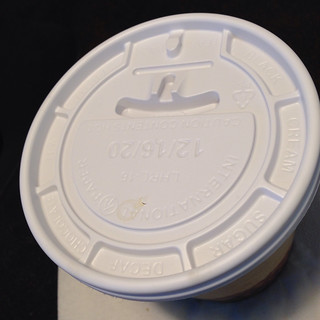
It's cold. So, I stopped at the Greenmarket for a hot cider on the way into the office, as I am wont to do. The guy put the cup down in front of me, while I fumbled for some money. And out of the corner of my eye, I read the numbers on the (unsidedown) lid.

today's date on a cup lid

12/16? Why's today's date on the lid? Is it an expiration date for what, the cider?

It took longer than it should have for me to realize that it read 12/16/20 - as in, what size cup in ounces the lid was for. I probably should have been at Starbucks buying coffee.

* * * * * * * * *

Puttering around my kitchen this weekend, I was bemused by the labeling on two household staples.

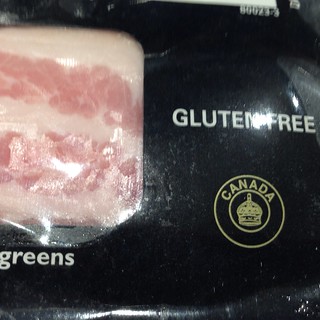
The bacon was marked as gluten free.

gluten free bacon

The sugar was marked as fat free.

fat-free sugar

Am I especially enlightened in that I already knew that bacon is gluten free and sugar is fat free? Because, frankly, I thought everyone knew that, in which case, WHY ARE THE PACKAGERS TELLING US THINGS WE KNOW?

04 December 2013

When It Rains...

I was sitting around chewing the fat with my father the other day when the subject of "It's Raining Men" came up - why, I can't say. It turns out that he loves that song, and knows all the words, and plays the CD in his car all the time - this, my seventy-eight year old, Fox-watching, conservative father, who voted for Nixon in 1960. I mumbled something about "gay anthem" but he dismissed that notion - "it's sung by some women", he says, "the Weather Girls". Then he tells me that he played it for my even older, even more conservative uncle while they were making Thanksgiving dinner, and that my uncle was "dancing around the kitchen to it like a maniac".

I'd like to say there's hope for us all, what with my father and his brother singing "It's Raining Men", but...

At least they know how to cook.

03 December 2013

Giving Tuesday

I had this idea that I was going to do a Giving Tuesday post about how to read a 990, and why you'd want to, and what you might want to look for, in case you wanted to check out how much net profit your local non-profit hospital was making and what the percentage of contributed income was, but instead, I decided to ask you to support a cause near and dear to my heart.

It's a tuition-free ballet program for New York City public school children. With an on-site public school. And an awful lot of laundry to do, each and every week.

Support Ballet Tech on Crowdrise


The 990 dissertation will have to wait. Just for the record though, Guidestar is a great resource where you can download 990s - which are the non-profit equivalent of an individual's 1040, also known as a tax return - for free.

So, if you're into Giving Tuesday, assuming you survived Black Friday and Cyber Monday, won't you please support Ballet Tech?

28 November 2013

A Cranberry Manifesto

I can't abide cooked, overly sweet cranberry sauce - you might as well put a jar of strawberry jam on the table with your turkey. I have no time for the cranberry sauce that plops out of a can, ridges and all. The raw cranberry orange relish? It's the only kind of cranberry sauce that graces my table. Cold, tangy, a nice biting edge, a good texture, it's the one I grew up on. See? Here's the recipe, in my mother's hand:


See her penciled notes? I can only assume - because I can't ask her - that once upon a time, cranberries came in a one pound bag. She had to adjust the recipe when they got downsized to 12 ounce bags, but you'll note that she dialed the sugar way back, catering to her own not-sweet tooth. It's better that way - brighter, bracing, an anti-dote to the heavy, rich gravy-mashed-stuffing-turkey assemblage on the Thanksgiving plate. It's why I like salad with my turkey - a bitter watercress and endive salad, dressed lightly with my favorite moscatel vinegar and some good olive oil, Sam Sifton be damned. (Also, Sam Sifton has never had Julia's purée de pommes de terre à l'ail or he wouldn't be all NO GARLIC IN THE POTATOES. I like a person with opinions, but I think he's got some funny ideas about Thanksgiving.)

Back to my mother and her cranberry recipe. Nowadays, you'd use a food processor, whirling electro-powered blades. But she says "food chopper". And what I remember is that she used an old-fashioned hand-cranked screw-onto-the-countertop meat grinder to make this, back in the day. If I were making the cranberry sauce, I might be tempted to dig out the meat grinder that attaches to the KitchenAid mixer, just to see, except that our mostly white kitchen would probably look like a crime scene afterwards. But I've no need, because my mother-in-law is bringing the cranberries - happily, she has no truck with the cooked stuff either.

Here's to you, and you, and you too. I'm grateful for all of you.

27 November 2013

The Aesthetics of The Innards

When you're rummaging around in your turkey tomorrow, see if you turn up one of these:


It's cool, isn't it? The farmer/lawyer/blogger we got our turkey from does his own butchering, and waxed rhapsodic about the loveliness of the gizzard.

When opened this way, the gizzard is an object of considerable beauty. The inner sac, with its ridged membrane, resembles a taupe-colored squash blossom. Once removed, the sac leaves behind a ridged slightly yellowy, flower-like impression, which contrasts with the deep red of the surrounding, pleasantly symmetrical muscle. The opened gizzard is as colorful and pleasingly symmetrical as any still-life subject—an opened fig, an oyster, or a skull by Georgia O’Keefe.

Alas, too often a supermarket bird comes without the usual innards: neck, liver, heart, gizzard. Besides being tasty additions to your feast, they're lovely and interesting. The neck reminds you that the chicken or turkey had a head, the neck reminds me that my grandmother always said it was the tastiest meat on the bird. The heart of a big bird? Feed your brain two ways, by poking it through with chopsticks or small fingers to figure out which chamber is which, and then by tossing it in your stock. And contemplate the beauty of the gizzard, and contrast that to its hard work of grinding: strength disguised.

Happy Thanksgiving!